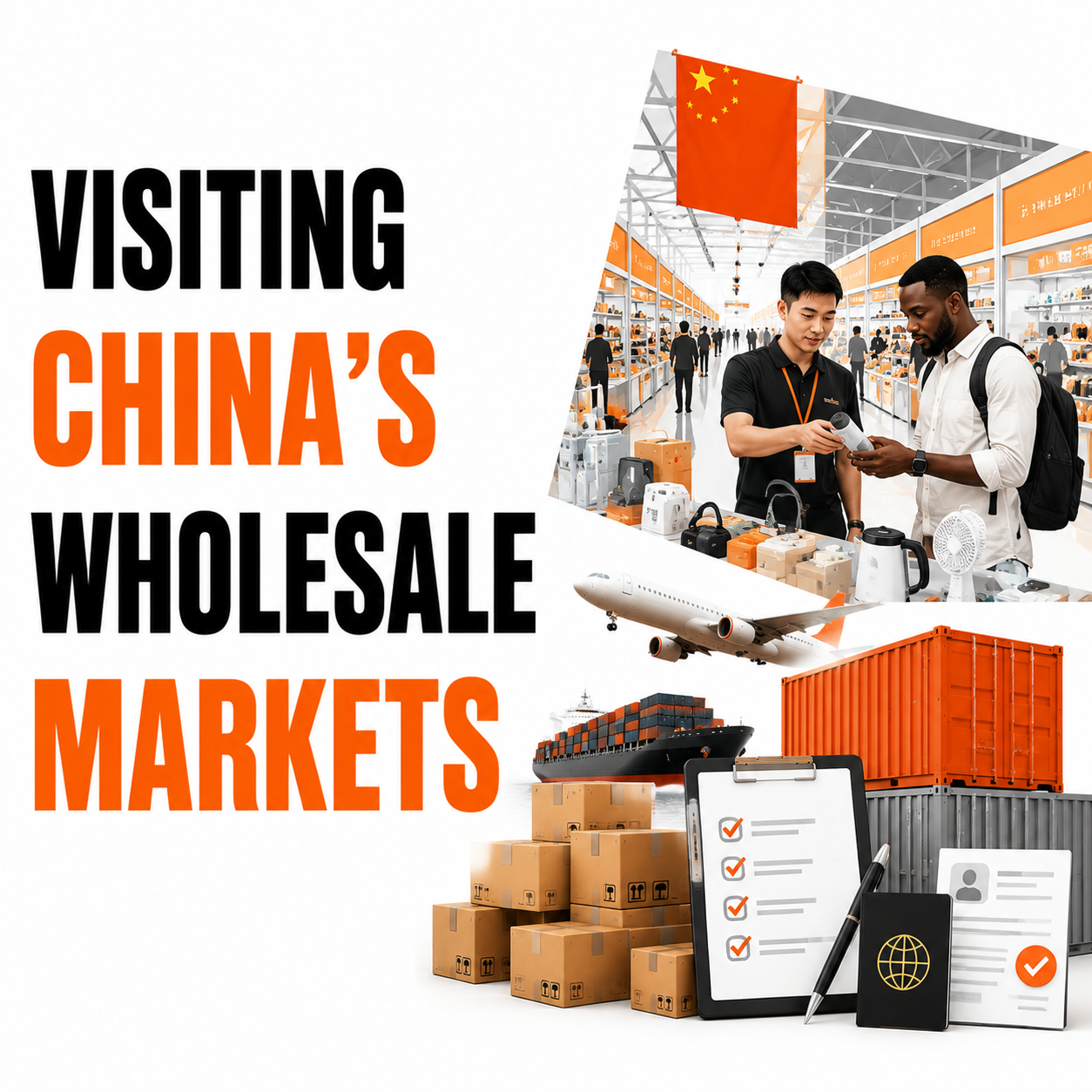
Visiting China's wholesale markets
4 min read
Which Chinese city sells what: Yiwu for general goods, Guangzhou for clothing, Foshan for furniture, Shenzhen for electronics. When to travel, how to plan, and how to work a market day.
Should you go at all?
You do not have to visit China to buy from it. We buy for customers every week who have never held a Chinese visa.
A trip earns its cost in two cases. You are placing a large order and want to see the goods and the people behind them. Or you are choosing what to sell for the long term, and you need to feel the quality with your own hands.
If neither is you yet, keep the airfare. Everything in this guide is something we can do for you.
Know the cities before you book
China's wholesale world is organised by city. Each one specialises, and landing in the wrong city costs you days. These are the ones that matter most to Nigerian buyers.
- Yiwu. The largest small goods market in the world. Tens of thousands of booths selling household items, kitchenware, toys, bags, stationery, gifts and accessories. If you sell a bit of everything, this is your city.
- Guangzhou. Clothing and textiles, shoes, leather bags, cosmetics and electronics. The Canton Fair happens here every spring and autumn.
- Foshan. Furniture, building materials, tiles and sanitary ware. An hour from Guangzhou.
- Shenzhen. Electronics. Huaqiangbei is the densest electronics market on earth, from phone accessories to components.
- Keqiao, in Shaoxing. The biggest fabric market in the world, near Hangzhou.
- Hangzhou. Clothing markets and China's e-commerce supply chains. It is also one of our two home cities.
When to go
Avoid Chinese New Year, in late January or February, and the first week of October. Markets close, factories close, and the hotels fill with people travelling home.
If you buy clothing or general goods, plan around the Canton Fair: April to May, and October to November. It is exhausting, and you see a whole industry under one roof. Book hotels early those weeks.
Keep your market days on weekdays. Booth owners have time, and the people who can actually agree a price are there.
Practical planning
Most Nigerian buyers travel on an M (business) visa, which needs an invitation letter. We write these for customers who come to see us. Flights from Lagos or Abuja usually route through Addis Ababa, Doha or Dubai, into Guangzhou or Hangzhou.
Stay next to the market you came for. Minutes matter when a market has 70,000 booths.
Alipay and WeChat Pay now take foreign cards, and that is how everything gets paid for, from taxis to samples.
Bring a translator or an agent. Prices come down and details survive when the conversation happens in Mandarin, and most booth owners speak little English.
How to work a market day
Comfortable shoes. Start early.
Photograph every booth you like: the booth number, the product, the price board. You will see hundreds of products by evening and your memory will not hold them.
Ask every seller the same three questions. The price at your quantity. The minimum order. The production time. Take the card, write the answers on the photo, and move on.
Do not pay a deposit at the booth, however warm the conversation. Orders and payments come later, in writing, after the company checks out.
Any sample you buy on the spot should go to one address in China, so they all leave the country together.
Or come with us
We host customers in Hangzhou and Yiwu. We build the days around what you sell, walk the markets with you, negotiate in Mandarin at the booth, and handle the samples, the orders, the inspection and the shipping after you fly home.
Tell us what you want to buy and when you want to travel. We will tell you honestly whether the trip is worth it, and which cities belong on it.